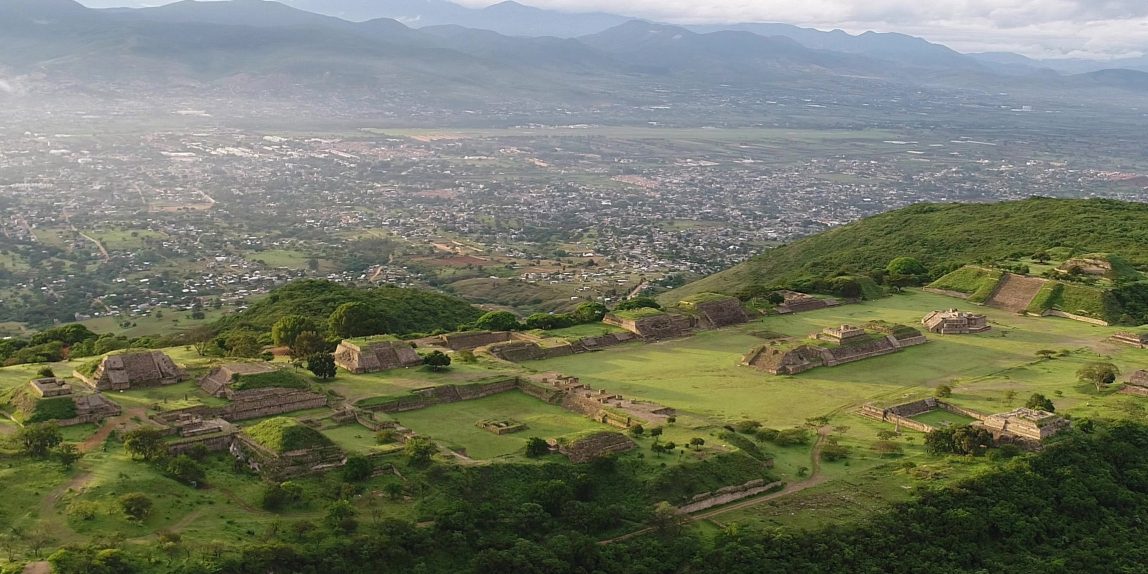
History
Brief Time-Line of Archaeological Fieldwork at Monte Albán*
——–Modern Era of Research———
*Note: This time-line does not provide an exhaustive list of all research projects carried out at Monte Albán. In particular, the list does not include some of the important conservation, salvage, and research projects carried out by the Instituto Nacional de Antropología e Historia (INAH).
Culture
During Monte Albán’s heyday, from 500 BCE to 800 CE, scholars believe the site was home to Zapotec (or Bènizàa) speakers. This attribution is based on studies of hieroglyphic texts from the site and general similarities to the Zapotec language spoken today. Following Monte Albán’s political collapse, however, other ethnic groups visited and used the site. Most notably, later groups reopened Classic Period tombs during the Late Postclassic (14-16th Centuries) to bury their dead. The most famous example is Tomb 7, which includes hundreds of offerings that are stylistically linked to Mixtec (or Ñuu Dzahui) people.
Information on Zapotec hieroglyphic writing from Monte Albán can be found here.
Information on Mixtec culture and language can be found here.
Chronology
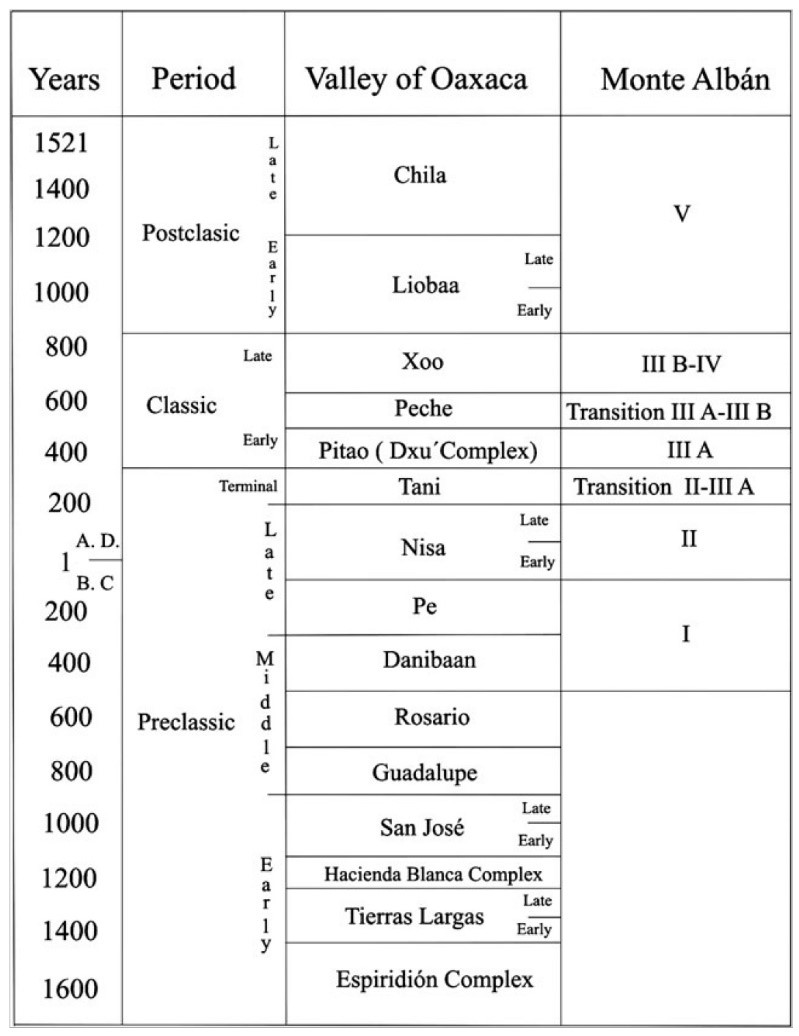
Archaeological understanding of Monte Albán’s history is based on the ceramic chronology devised by Alfonso Caso, Ignacio Bernal, and Jorge Acosta and presented in La Cerámica de Monte Albán (1967). Caso’s chronology utilized roman numerals, beginning with the site’s founding in Period I and ending with Period V. Subsequent research at Monte Albán, however, found irreconcilable issues with the chronology that led Marcus Winter, Cira Martínez López, Robert Markens, and Michael Lind to propose a new chronology utilizing phase names (e.g., Pe, Nisa, Tani). A chart presenting the revised chronology alongside Caso’s original version appears below (from Winter 2011).
Links
Monte Albán UNESCO World Heritage Site
Monte Albán Archaeological Site Museum
Catalog of Zapotec Effigy Vessels
CyArk Digital Scanning Project at Monte Albán
Santiago Laxopa Zapotec Language Project
The Ticha Project: A Digital Text Explorer for Colonial Zapotec
Mesolore wesbsite with tutorial on Mixtec writing and Codices
Links to Books on Monte Albán and Oaxaca
Urnas de Oaxaca. By Alfonso Caso and Ignacio Bernal. 1952. Instituto Nacional de Antropología e Historia, Mexico City.
El Tesoro de Monte Alban. By Alfonso Caso. 1969. Instituto Nacional de Antropología e Historia, Mexico City.
Zapotec Writing: Knowledge, Memory, and Power in Ancient Oaxaca (Download Part 1, text & Part 2, figures). By Javier Urcid. 2005. Foundation for the Advancement of Mesoamerican Studies, Inc. Crystal River, FL.
Los Pueblos Indigenas de Oaxaca. Atlas Etnográfico. Edited by Alicia M. Barabas, Miguel Alberto Bartolomé, and Benjamin Maldonado. 2004. Instituto Nacional de Antropología e Historia, Mexico City.
PAPERS/PUBLICATIONS
CONFERENCE PRESENTATIONS
Geophysical Prospection of Monte Albán’s Main Plaza: An Overview of Results (A. Regnier, S. Hammerstedt, and M. Levine). Paper presented at the 83rd Annual Meeting of the Society for American Archaeology. Washington D.C., 2018.
Mapping from the Heavens: UAV(Drone) Data Collection at Monte Albán, Oaxaca, Mexico. (A. Badillo and M. Levine). Paper presented at the 83rd Annual Meeting of the Society for American Archaeology. Washington D.C., 2018.
Monte Albán’s Main Plaza: New Perspectives Gained through Geophysical Prospection and Digital Mapping (M. Levine, A. Badillo, S. Hammerstedt, A. Regnier, and M. Winter). Paper presented at the 83rd Annual Meeting of the Society for American Archaeology. Washington D.C., 2018.
The Discovery of a New Buried Building on Monte Albán’s Main Plaza (S. Hammerstedt, A. Regnier, and M. Levine). Paper presented at the 83rd Annual Meeting of the Society for American Archaeology. Washington D.C., 2018.
PUBLICATIONS
Levine, Marc N., Scott W. Hammerstedt, Amanda Regnier, and Alex E. Badillo 2021 Monte Albán’s Hidden Past: Buried Buildings and Sociopolitical Transformation. Latin American Antiquity 32(1):76-98.

